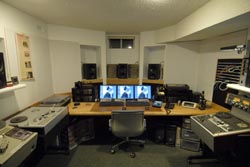
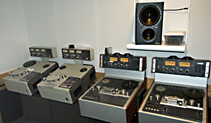
The Studer A80RC as designed stops only when both tension sensors lose tension. When using fragile archival tapes, especially at slower speeds, this creates some difficulties as the tape end weaves through the head block. Here is a modification which makes the A80RC operate like an A810, stopping the tape when either tension sensor looses tension. The mod is completely done on the 1.081.393 Command Receiver board and involves adding two parts and removing one.
(more…)
I apologize, but I have been receiving 2000 spam comments a week recently and it fills up my inbox and the users have to be deleted. They’re not going to get their comments posted, but I’m tried of this. If you wish to leave a comment on this blog, please email it to me and I will post it in the article. Sorry. I am moving all the excellent comments into the articles and that should be done shortly.
The format page for 0.15 inch wide tape has a drawing (click for large version) that clearly shows that mono cassettes have one wide track and stereo cassettes split this track in half and add a small guard band. Most mono cassette recorders follow this format. It turns out that the mono Marantz PMD201 uses a two-channel head and records dual mono. Most other mono recorders seem to follow the standard.
While this is a theoretical problem, few if any good mono recorders are available for reproducing these tapes anyway, so most of us in the domain transfer field use good quality stereo machines for all cassette transfer work. (more…)
For many years, I had been in favour of the Primera Z1 small optical disc printer. When Primera discontinued this several years ago, I was not pleased and purchased two as spares, hoping at least the ribbons would continue.
It appears that I am not alone in thinking this is a good product as it has resurfaced as the U-Print CDP78, now in black, and available from many online distributors. The cartridges appear to be interchangeable with the Primera. I can now suggest that this is a good alternative for safe, long-lasting, and reasonably attractive text labeling of CDs and DVDs. It appears that the Teac P11 is also similar. The last time I checked, the Casio required manual rotation of the disk, rather than the Primera’s automatic rotation.
Please provide me with any feedback pro or con—preferably as comments to this post.
It has become obvious to me that there are good ways and bad ways to pack equipment for shipping.
There are some basic goals that one needs to achieve in the packing.
- Protect the equipment from excessive shock and vibration
- Keep the equipment solidly centred within the outer box(es)
- Keep the equipment safe from small object impacts
- Prepare it to be dropped
(more…)
If you ever worry about a bit error happening to your files and not finding out about it, you should use MD5 checksums (or some similar method) to be able to verify that the file has not changed.
The general theory behind a checksum (or “Message Digest” = “MD”) is that it provides a unique 128-bit number for each and every file, based on its content. If one bit changes, the MD5 checksum (sometimes called “hash”) changes. The checksum is repeatable, does not permit discovery of two different files that produce the same checksum, and is non-reversible (i.e. you can’t create the content from the checksum). (more…)
It appears that many old acetate tapes when played on high-quality audio recorders will suffer spoking when left in a play wind condition. I have discussed this problem here. Since posting that, I have taken one of my Racal Store 4DS recorders and removed the heads to save them from wear and now use that to re-spool any tape that shows spoking when played on a Studer A80, Sony APR-5000, or Studer A810. (more…)
The Training for Audiovisual Preservation in Europe (TAPE) Project has just published an excellent Audio Tape Digitisation Workflow document here. It is authored by Juha Henriksson of the Finnish Jazz & Pop Archive and Nadja Wallaszkovits of Phonogrammarchiv, Austrian Academy of Sciences. It is aimed at the newcomer but still addresses all of the major points without being overwhelming. (more…)
Once again, an interesting post on Jill Hurst-Wahl’s Digitization 101 Blog. She started by discussing tape backup issues. In the comments, I discussed my solution of using multiple spinning disks. Another commenter, Ike, provided an extensive review of file system options and his opinions on what works (and doesn’t) for long-term storage. Ike’s comment is fascinating and has lots of food for thought. Here is the post. (more…)
My friend Susan Kitchens blogged about the history of the electret as in electret condenser microphone. It’s an interesting piece of history. I added a little primer to the post on microphone basic types. Look here.