The Studer A80RC as designed stops only when both tension sensors lose tension. When using fragile archival tapes, especially at slower speeds, this creates some difficulties as the tape end weaves through the head block. Here is a modification which makes the A80RC operate like an A810, stopping the tape when either tension sensor looses tension. The mod is completely done on the 1.081.393 Command Receiver board and involves adding two parts and removing one.
reels
Studer A80 Covers — protection and more work area
A simple, 5-sided box solves two problems:
–Protection of the Studer A80
–Providing more work surface
Success with squealing Shamrock 031 tape
I spent days trying to get Shamrock 031 to play without much success. Since this is an Ampex factory budget brand (probably non-spec premium tape) I thought that it might be suffering from Sticky Shed Syndrome. I baked it for 12 hours and it still squealed. I then tried my usually successful cold playing technique and it still squealed. Cold playing has worked successfully with 3M 175 and Sony PR-150.
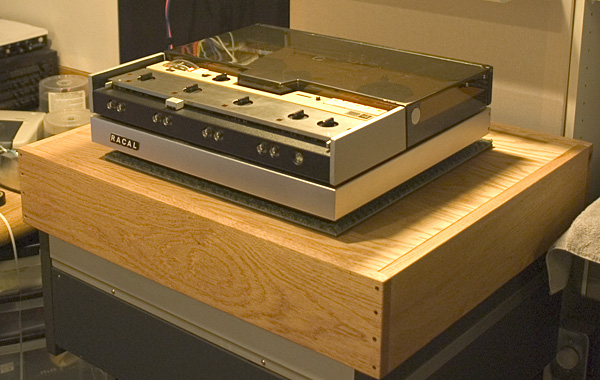
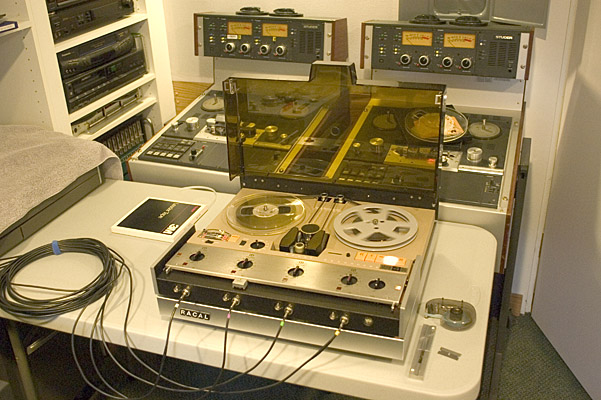
I was getting rather frustrated and since it was a four-track tape and one of the techniques that is supposed to reduce squeal is to play the tape faster, I dragged out my Racal Store 4DS instrumentation recorder which has a 75,000 Hz bandwidth at 15 in/s and played it at 15 in/s and digitized it at 88,200 samples per second. After slowing it down 4x and ending up with a 10 kHz bandwidth (which I subsequently truncated to 5 kHz since there was no useful information above that, but lots of noise–same as the non-squealing portion of the real-time transfers on a Studer A810).
Securing the end of a tape to the reel
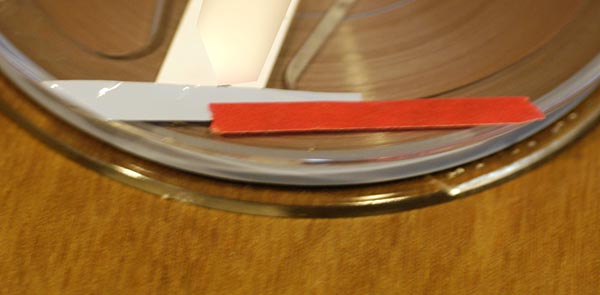
I receive many tapes that use very creative methods of securing the end of tapes to reels. Some don’t do it at all. Most 1/4-inch tapes are secured as shown below. Sadly, the superior Zebra tape is no longer available. This is the traditional crepe-paper type of tape sold for the application. The picture below should explain all.
Azimuth: Hows and Whys
There is a recurring question as to what is the best way to set azimuth for playing a tape. Many people assume that using the test-tape alignment is best. Well, that makes another big assumption: The recorder used a proper test tape alignment. While that can be the case, it usually is not.
Let sleeping tapes lie—what to do with poorly wound tapes
Often a tape comes in for restoration that has been poorly wound or poorly stored. Here is an example:

One of the interesting things about this particular tape was it had been recently wound on a constant-tension professional machine prior to shipping to me.
We think that the entire tape had not been re-wound, allowing the higher tension wind to compress the inner core slightly, causing this cinching. After transferring the tape (which didn’t show much ill effect for its cinching), we still found it difficult to get the tape to wind smoothly on the reel.
Therefore, our current suggestion is if you find a tape like this, do not rewind it and attempt to clear up the cinching unless you are also ready to transfer the tape, as there are no guarantees that it can be wound better after unwinding.
Please see this post for an update (2008-02-15).
Tape recorder bias frequencies
The discussion of what bias frequencies were used over time keeps recurring. Special thanks to Jay McKnight of Magnetic Reference Lab, Tom Fine, and Brian Roth for input to this list. I posted this to the ARSC list, but wanted to include it here as well. This knowlege is useful for those who wish to archive the bias along with the audio for future application of time-base-error correction tools such as the Plangent Processes.
Bias frequences started low, apparently with 60 kHz for early consumer recorders, but Ampex started with 100 kHz. Other later machines used different bias and erase frequencies. We can see with a few exceptions, the top bias frequencies were commonly limited to 250 kHz for audio, with the Sony APR series and the Ampex ATR series in the 400 kHz region. For cassettes, a practical maximum appears to be about 150 kHz. Much higher frequencies (up to at least 8 MHz) were used in instrumentation recorders. An enumeration of several machines follows.
Binder adhesion to back of next layer
In several instances, we have seen binder adhesion to the back of next layer in the tape pack. When the tape is unwound, a portion of the the binder adheres to the layer it was resting on, and is pulled off the layer it was supposed to be on. It looks like this when held up to the light:
 There are many possible causes for this adhesion (or pinning, as it is sometimes called). For this tape, we believe moisture intrusion and poor storage conditions contributed to the problem. It is often a problem with plastic leader tape.
Slow unwinding has reportedly helped, as has cold, dry storage for an extended period.
This tape (Melody 169) also squealed, but we finally got an acceptable transfer. Fortunately, this was recorded on only one track, and it wasn’t the one with all the holes in this picture.
New perspectives on squealing tapes
Martin Fisher from the Center for Popular Music at Middle Tennessee State University wrote me this morning and he identified a subtly different failure mode that I had not specifically thought of previously. I think the following best describes it and its remediation.
Manufactured with insufficient lubricant: This is a defect that appeared at birth, so while not a degradation (i.e. getting worse over time), it will still cause issues with reproduction. What distinguishes this failure mode from “Squealing, limited shedding” is that there is frequency modulation introduced during the original recording which was presumptively made when the tape was new. While adding additional lubrication will reduce the frequency modulation during playback (which is very important), it will do nothing to correct the recorded-in frequency modulation. The only method of correcting that is bias capture with the same head as the audio capture and running the resultant files through the Plangent Processes.
Acetate tape re-hydration
John Chester reminded me of an October 2005 post that I made to ARSCLIST that I had not mentioned in depth here. To keep as much information as possible in this one place, I thought I’d re-post it here with minor edits for clarity 13 years later:
Friedrich Engel, the retired BASF historian, gave me a present in a phone conversation (yes, to Germany, his English was far better than my German). You can re-hydrate acetate tapes.
Images of Scotch (3M) tape boxes available
| I was interested in the progression of the Scotch/3M tape boxes over the years, especially after Carmine Lauri contacted me because his father was in the picture of a chamber orchestra on the 1960s Scotch tape boxes. Click on each image to see a larger one. Any moire pattern you may see is the screening of the printing on the box beating with the pixel/dot pattern of your monitor. |
 
|
Studer A80 RC modifications for 1/2-inch two track and other modifications
In a discussion on 2012-01-20 in the New Studer list, Todor Dimitrov posted the differences between the record and repro boards between a 1/4-inch and a 1/2-inch two-track A80RC repro cards. Here are the changed components for the 1/2-inch version. There are five different oscillator versions in the manual, including one for 1/2-inch.
RECORD: C34=68pF
REPRO: R1=100K; R21=330
Note that the mechanical modifications between 1/4 and 1/2-inch tape handling may be substantially more complex in terms of tuning the transport. I know of no definitive notes on this subject. [Added 2013-10-09]
CBC A80RC Repro capacitor mod
I had previously posted in the original (and now reconstituted) Studer List on 2008-04-24 that there were other extant and possible modifications. Here is a slightly edited and reformatted version of that post:
Sony APR-16 Memory Locations (APR-24)
The 108 memory locations for storing setups is a real feature of the APR-5000 series tape machines. The APR-24 manual alluded to this but did not provide any instructions.
I have the only APR-16 that Sony ever made, but it is essentially the same as an APR-24. My APR-16 is running firmware version 5.01.06.0.
It appears that there are a total of 18 total preset locations in the APR-16 (and presumably the APR-24).
Sony APR speed experiments
We have been wondering just how far we can push the Sony APR-5000 capstan servo system, so we ran a few tests using an external oscillator feeding the reference port. Unlike Ampex, Otari, and Studer machines which use an external reference of 9,600 Hz; the Sony machines use an external reference of 19,200 Hz.
We found that the APR-5000s did not run reliably below 1.88 in/s — and that is achievable with a -50% varispeed already. It didn’t matter what the base speed was.
The APR-16 (cousin of the APR-24) did not run reliably below 3.75 in/s. But the good news was that we could bring 15 in/s down to 3.75 in/s using the external reference source. We were also able to run the APR-16 at 60 in/s, but takeup tension was a bit low.
Sony APR-5000 Hum Shields not working
I got a call today from a friend who said the hum shields on a friend’s APR-5003 were not working.
I recalled this had happened to one of my machines in the past.
Removing the cover surrounding the heads will expose the mechanism—of course the heads and pinch roller need to come off first.
Cleaning and lubricating the rods and other parts of the linkage should make all well again.
I used Zoom Spout Turbine Oil.
Analog "Warming up" of sound & the use of obsolete formats in contemporary recordings
I received a phone call today from someone who wanted my opinion on a Tascam 238 8-track cassette recorder for recording his music.
This was like the person who wanted to know about the DCC recorder for the same purpose yesterday.
People keep hearing that “analog sounds great” or that this or that format “sounds great” and they want to buy in.
Noise Reduction Basics
\”Noise Reduction\” is a potentially confusing topic, partially because it has come to be used to mean two different things.
- Today, it means removing noise from a recording by means of a single-ended post-production device or plug-in, such as Noise Free Pro by Algorithmix that I use (among other tools).
- Historically, the term was used for a double-ended process where the dynamic range of the program material was reduced in an unobtrusive way, transported by the noisy channel (be it tape or broadcast) and then expanded in a complementary fashion at the end/output of the noisy channel. These devices were generally referred to as companders (a contraction of compressor/expander).
When reviewing old tapes, they may be marked in various ways to indicate their noise reduction compression, or processing. As of this writing, there are no software plug-ins that accurately mimic the action of the hardware compander acting as an expander. We use actual companders from the original systems when restoring tapes made with these systems.
We currently handle nine different formats from four manufacturers and are always on the lookout for more. Most manufacturers sold a variety of systems tailored to the needs of different kinds of transmission/recording channels
See our special page under formats (click here) to see some of the information we’ve gathered about noise reduction techniques used over the years. Check back as we uncover additional formats and information.
Project Notes: Crosstalk on a cassette
I received a cassette from a client and he complained that the previous recording was audible as well as the new recording.
There are several ways this can happen:
- The erase head can be dirty—this usually leads to high frequencies being erased and lower frequencies still audible
- The erase head can be misaligned—this often provides a partial erasure, but careful use of track selection can find a section of track with less crosstalk.
- A similar problem occurred on quarter-track reels with misaligned record heads where recordings from the opposite direction would invade the tracks for the forward directions. Again, a specially adjustable narrow head usually solves this.
- A completely non-functioning erase system—this is what we suspect happened with the current project. There were no track dissimilarities nor any other way we could find, including looking at the tape with the 8-track cassette recorder to separate the underlying, unwanted recording from the wanted one.
- A totally unrelated mechanism that may sound the same is if the microphone or tape recorder picks up a broadcast or other radiated signal and records that along with the desired signal.
We opted not to proceed with any noise gating as it would not improve the overall audio quality for listening and may actually impede transcrption.
While not a success, we were able to confirm to the client that there was no way that could preserve the fidelity of the desired sound and remove the undesired sound. The desired interview was completely intelligible and could be transcribed. It was just distracting to listen to.
Demagnetizing recorders and heads
Demagnetizing tape heads and recorder parts is a ritual of magnetic recording. If any part that touches the tape is magnetized beyond a certain level it will begin degrading the tapes played on it.
While early machines may have had an issue with magnetization, most late-model machines rarely become magnetized. The source for real information on this is Jay McKnight’s Magnetic Reference Lab Web site.
How to archive recordings — a quick guide to resources on this site
You’ve been asked to digitize recordings in your collection and don’t have any idea where to start. There are several resources on this site which might be of use.
What I use is shown on my facility page. That\’s one of the main reasons it is there. If I’m using it, it’s because I like it or it solves a problem for me. If I’m not using it, either I don’t have an opinion about it, won’t spring for it, or don’t like it.
Alternate tape equalizations—Teac Extra Efficiency
While the Ampex Mastering Equalization is well documented on this site and at the MRL site, and standard equalizations are detailed at the MRL site on page 3 of this document, I am always amazed when I discover additional, supported tape equalizations. Certainly there have been proposals for alternate equalizations. Jay McKnight has published a paper (here) about this. This post is about something different.
Teac Corporation, with their X-2000M reel-to-reel tape recorder included a button called “Extra Efficiency” to be used with then-new tapes that had double the coercivity of standard reel-to-reel audio tapes. This changed the recording equalization (and the bias and possibly the reference levels) to better make use of the new tapes to improve the overall sound.
What was fascinating here is not that they used the IEC standard equalization of 35 μs at 15 in/s, which was standard in Europe, but that they also invented their own standard and used 35 μs at 7.5 in/s as well! Not content with that, they invented yet another standard of 50 μs for 3.75 in/s.
The NagraMaster and StellaMaster equalizations are also non-standard and were probably the most widely adopted equalizations after AME, but who knows how widely used this Teac EE equalization was and who knows what tapes are in archives that had this equalization incorrectly applied.
I have been informed that it was only intended for the consumer market.
Noise reduction plug-ins
The question seems to regularly arise on mailing lists and chat rooms about Dolby and dbx plug-ins. I don’t think it will happen and I added that comment and some hopefully helpful operational hints to my noise-reduction page, here.
Aligning a tape recorder
It seems some people new to tape are confused over how to align a tape recorder. This is the abbreviated version.
If you want to record on a tape recorder (and I do not recommend doing that these days as you’re just generating more tapes that will need to be transferred later) the first thing to do is get the playback correct.
- CLEAN the machine.
Tape speed, track width, frequency response, and dynamic range
There are complex interactions between tape speed, track width, frequency response, and dynamic range. This article is an attempt to summarize the major influences.
How to play 4-track 1.875 in/s tapes…
I received a query from a gentleman in Europe about 1.875 in/s 4-track tapes. He was frustrated in finding a good machine for transferring them. Apparently, they have many of these tapes. Here are my suggestions.
Perhaps the easiest answer is to find a Studer-Revox C274 with low speed options. They were made.
Two other options.
Using the proper tools…and don’t try this at home!
I didn’t think I needed to write this post, but it appears that someone purchased a Racal Store 4DS Instrumentation Recorder at least partially because I mentioned it, hoping that it would work as a four-track recorder for creating music.
Playback of NAB 2-track tapes on a DIN Stereo (Butterfly) head
I received a query from Sweden today asking
I have a Studer machine with butterfly heads with which I’d like to reproduce
tapes recorded with normal two track heads. Theoretically, how much more noise,
in dB, would I get from playing the “empty” part of the tape?
Let’s look at the assumptions.
RCA “Sound Tape” cartridge and 1/4-track reel introduction dates
David Dintenfass kindly sent me an article from the October 1959 issue of Popular Electronics which says, in part, that RCA plans to have 65 titles in the stores in their new cartridges by Christmas 1959. Other manufacturers were shown to be making compatible players.
Magnetic Tape Splicing
I received an email asking me to discuss tape splicing. Most of my work is now repairing old splices so I try and butt them together as best I can in an Edi-Tall block and use the blue Quantegy splicing tape (which will become harder to find with Quantegy exiting the business). I will not be evaluating a replacement for several years as I bought a large supply a few years ago.
Slow speed 4-channel cassette digitization
There has been some discussion recently about the 4-channel cassette recorders that were used for court reporting and other logging- or court-reporter-type applications. It seems that the players only have one output and can select any combination of one or more playback channels into that one output.
This monitoring topology is actually identical to two 1-inch 40-channel reel-to-reel logging machines I have where one can listen to any combination of one through forty tracks on a single output.